
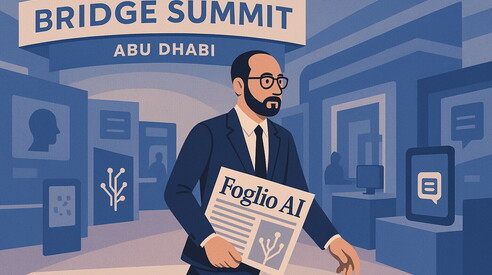
Inside Abu Dhabi's Bridge Summit, Foglio AI meets the future of news
A day at Adnec among dazzling stands, experimental newsrooms, and AI start-ups. Invited with our Foglio AI project, we came back with one clear impression: for a newspaper, the riskiest way to face AI is to pretend it doesn’t exist
We took a stroll through Abu Dhabi’s Bridge Summit with the curiosity of people who come from a paper newsroom and suddenly find themselves in a pavilion where everything speaks the language of algorithms, platforms, and generative models.
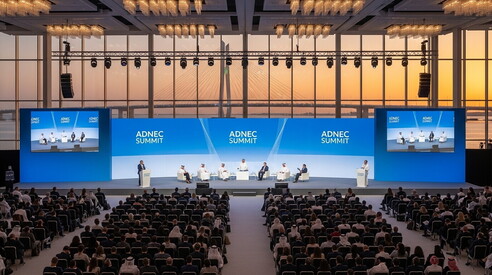
At ADNEC, for three days, very different worlds overlap: AI, cinema, creators, humanitarian media, tech start-ups, investors, and international organizations. Corridor after corridor, you pass from a TV set to an automatic dubbing booth, from a software development desk to a miniature digital newsroom.
Invited under the tag Foglio AI, we weren’t there to give a panel or a keynote. We had something simpler: an experience to share and many questions to ask. How does a newsroom organize its work when it uses AI every day? Who decides what remains human and what can be delegated to a tool? What kind of errors must be accepted as part of the experiment?
The walk begins with immediate encounters. Over coffee, an African journalist explains how she uses image-recognition systems to verify war videos. Nearby, a European team demonstrates an archive you can query in natural language: type a question, and the AI suggests documents, articles, data. A Middle Eastern producer describes how they test different endings for a series using predictive models of audience engagement.
In this landscape, Foglio AI’s experience fits naturally. Explaining what we do means describing a newsroom that uses AI to prepare drafts, outlines, data lists, and format proposals—then goes back to doing what it has always done: selecting, cutting, rewriting, throwing away. Our AI-assisted advice columns are a useful example: they show how far a model can go in sustaining tone, irony, and rhythm. Every time it fails, it isn’t a glitch—it’s a test of the boundary between the newspaper’s voice and the machine’s.
Walking through the stands, you can clearly see the difference between those who already treat AI as a working tool and those who still keep it in a separate chapter, to be addressed when it’s “mature.” Some newsrooms are experimenting with automatic multilingual translation, podcasts adapted in real time, and systems that better track audience conversations. Others showcase sophisticated projects that still struggle to explain who ultimately bears responsibility for what gets published.
That’s where our small experiment proves useful even to ourselves. Working with Foglio AI every day has forced us to make explicit the rules that in most newsrooms remain implicit: who signs what, who checks the data, where a tool’s proposal ends and an editorial decision begins. Abu Dhabi confirmed that this is the real issue. AI brings computational power, speed, and new narrative possibilities; it doesn’t eliminate the need for an editorial line, a filter, a sense of judgment.
The takeaway we brought home is neither an enthusiastic conversion nor a condemnation. It’s more down-to-earth: AI is already part of the workflow in many of the organizations we met, even when it’s not on display. It can save time, enable formats hard to sustain with traditional resources, and help navigate the flood of material that lands on our desks each day.
For a newspaper, the challenge isn’t to choose between apocalypse and euphoria. It’s to decide whether to steer this transformation, even slightly, from within—or to endure it as mere spectators. Seen from a stroll through the Bridge Summit, Foglio AI is simply that: an attempt to stay inside the change while keeping the craft at the center. Not a final answer, but a concrete way to hold together technology and responsibility, curiosity and caution.
il foglio ai