
foto Getty
Exclusive
Saipem is studying the construction of the first private refinery in Libya
The preliminary project is unprecedented and would help the country free itself from dependence on foreign diesel supplies. The role of Muheet Oil Refining and the doubts about its owner, Ahmed Gadalla
Libya is trying to free itself from a paradox: being the African country with the largest oil reserves, yet forced to import much of its diesel needs. A wealthy businessman from Benghazi, Ahmed Gadalla, now intends to develop, with Italy’s help, the country’s first private refinery. According to Gadalla himself, speaking to Il Foglio, the Italian company Saipem, a leader in engineering, drilling, and the execution of large projects in the energy and infrastructure sectors, has been contacted by Muheet Oil Refining Co., controlled by the so-called Alushibe Group, an umbrella of companies all owned by Gadalla. A project that could have a significant impact in Libya, though many aspects still need clarification — not least, who Ahmed Gadalla really is.
The Libyan entrepreneur himself explained his intentions during a phone conversation with Il Foglio. “I want to modernize the country with state-of-the-art facilities to put an end to the current system that makes Libya so dependent on diesel imports. We are major oil producers; we must focus on this, and we are starting a dialogue with Saipem to expand the oil refining system in the country. Because I want a strong and prosperous Libya.”
At the moment, discussions with Saipem are still at a preliminary stage, focused on a feasibility study for the construction of the refinery, which should be built in eastern Libya. However, the groundwork is there, as official data provided by the Libyan Central Bank confirm that Muheet Oil Refining Co. had already received, as of December 31 last year, letters of credit totaling just over 75 million dollars, despite a period of severe crisis for the Tripoli-based institution, plagued by chronic instability and lack of liquidity.
The involvement of Saipem, whose main shareholder is Eni, is part of a more ambitious plan announced last January by the president of the National Oil Corporation (NOC), Masoud Suleiman. The goal is to double refined oil production capacity, increasing it from the current 380,000 barrels per day to 660,000 barrels per day. Suleiman himself noted that the main limitation of refining in the country lies in the obsolescence of infrastructure, which is inadequate to meet energy demand. Of the 51 million barrels per day of diesel placed on the market in 2024, only 13.8 million were refined in Libya.
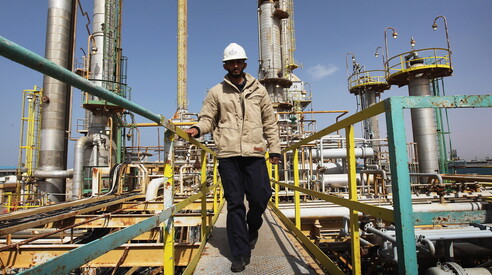
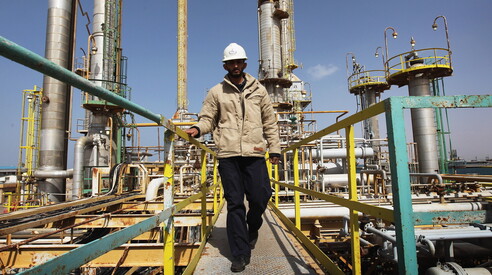
The fact that only four refineries are currently operating in the North African country, all outdated and owned by the NOC, has forced Libya to import large quantities of diesel, especially from Russia. The unchecked subsidy system that has pushed fuel prices down — Libya today has the cheapest gasoline in Africa, at just $0.03 per liter — has had catastrophic consequences, fueling smuggling. According to a report published last November by Sentry, an investigative organization based in Washington, roughly 20 billion dollars in oil revenues vanished between 2020 and 2022, money that could have been used to build infrastructure and provide essential services to the population but instead ended up in illicit trade. Enormous losses have been recorded more recently as well, because, again according to Sentry, Libya lost another 6.7 billion dollars in 2024 alone. The effects of the inefficiency of Libya’s oil sector have been dramatic: “Inflation, the consolidation of power by the Haftar family in Benghazi and, to a lesser extent, by the Dabaiba family in Tripoli, as well as the fact that external actors, including Russian armed units and Sudan’s Rapid Support Forces, have benefited from Libya’s diesel crisis.”
At the center of this system is said to be Saddam Haftar, deputy commander-in-chief and son of General Khalifa. According to a report by the United Nations Panel of Experts, the Haftars are implicitly involved in crude oil smuggling through Arkenu, an oil company founded in 2023 and allegedly linked to Saddam, who, in addition to having significant influence within the NOC, controls the ports of eastern Libya and the southern borders, the hubs used for diesel smuggling.
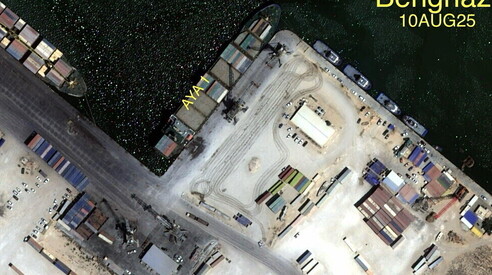
Gadalla, who by his own admission is very close to the Haftars — “anyone who wants to do business in Benghazi must have relations with them,” he told us — says he wants to “create thousands of jobs.” Little is known about him. At the end of August last year, documents and testimonies collected by Il Foglio showed that the Libyan entrepreneur is suspected of trafficking military-use equipment from the United Arab Emirates to Benghazi and ultimately to Sudan, for the benefit of the Rapid Support Forces in Darfur. Uds Shipping Services LLC, the company suspected of violating the UN arms embargo imposed on Libya, appears to be connected to the so-called Alushibe Group. Contacted by Il Foglio, Gadalla rejected all accusations. Much of his business is based in the United Arab Emirates and in Europe, but it is in Libya that he is now concentrating his investments. In Benghazi, he enjoys enough trust to have secured substantial letters of credit from the Libyan Central Bank, not only for the benefit of Muheet — of which no corporate details are known, aside from an address in Benghazi — but above all for Waad Libyan Company for Cement and Building Materials, a cement company also owned by Gadalla which, as of December 31, 2025, had received more than 177 million dollars. No other company in Libya received that much money from the Central Bank last year.
This article was translated using artificial intelligence.
-
Sono nato a Latina nel 1985. Sangue siciliano. Per dimenticare Littoria sono fuggito a Venezia per giocare a fare il marinaio alla scuola militare "Morosini". Laurea in Scienze internazionali e diplomatiche a Gorizia. Ho vissuto a Damasco per studiare arabo. Nel 2012 sono andato in Egitto e ho iniziato a scrivere di Medio Oriente e immigrazione come freelance. Dal 2014 lavoro al Foglio.