
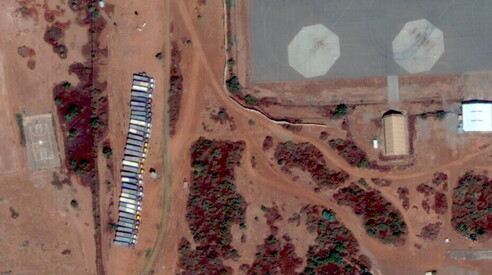
La colonna di camion carico di uranio parcheggiata alla Base 101 di Niamey (Casus Belli)
Exclusive
Inside Russia's Air Route for Transporting Uranium from Niger via Libya and Syria
Aboard an Antonov, from Niamey to Moscow: the long journey of yellowcake extracted in Arlit and purchased by Rosatom. Stopovers in Libya and Syria, and the decoy of a cargo ship waiting in Lomé
Russia has begun moving a thousand tons of uranium through an airlift from Niger, making stopovers in Libya and Syria, as shown by satellite images and testimonies collected by Il Foglio. The final destination of the raw material extracted from the African country is not certain, but since it was purchased by Rosatom—considered an economic arm of the Russian occupation forces in Ukraine—it is possible that part of the cargo may be destined for the Zaporizhzhia nuclear power plant, which is controlled by the Russian company. Russia’s purchase of the uranium is contested by Orano, the French company that still legally controls the Arlit deposit. Above all, the entire affair reconstructed by Il Foglio demonstrates how Russia is able to use its military bases in Libya and Syria as bridgeheads for its operations in the Sahel and to fuel its war in Ukraine.
For weeks, at least one aircraft—an Antonov An-124 with registration code RA-82037—has been shuttling between Moscow and Niamey, the capital of Niger, rendering itself invisible by switching off its transponder, the satellite device that allows its route to be tracked. Even with the device turned off, however, radar systems continue to follow aircraft, and according to intelligence sources, the cargo plane has recently made at least nine stopovers in Niamey, where the coup-born junta that came to power two years ago is openly pro-Russian. The cargo consists of an enormous quantity of yellowcake, the name given to uranium at an intermediate stage before its final conversion for nuclear processes. Most uranium transport occurs precisely at this stage because it is simpler and less expensive. The material is packed into drums that can each contain up to 400 kilograms of yellowcake, which is highly toxic and has a certain level of radioactivity, albeit reduced. For this reason, its transport requires special precautions and specific authorization from the IAEA, the International Atomic Energy Agency—an authorization that was obviously never requested nor granted by the UN agency.
The uranium in question was extracted at the Somaïr mine in Arlit, in northern Niger. After concluding a commercial agreement with Russia’s Rosatom, the Nigerien junta organized an extremely dangerous transfer of the cargo, bordering on the unthinkable. Transported aboard around fifty trucks, the convoy that departed Arlit at the end of November crossed several provinces infested by jihadists from the Islamic State’s Sahel Province. The trucks belong to the company MB Trans, owned by Nigerien businessman Mohamed Baye, known in the country for his ability to move dangerous materials through high-risk areas. Videos circulated on social media show the trucks escorted by armed guards, including not only Nigerien forces but also men from the Africa Corps, Russian mercenaries.
Initially, it was thought that the convoy would cross into Burkina Faso, then pass through provinces controlled by the Group for the Support of Islam and Muslims (JNIM), linked to al-Qaeda, and finally enter Togo to load the uranium at the port of Lomé on the Gulf of Guinea. Attention was focused on the Matros Shevchenko, a Russian-flagged ship considered suitable for transporting uranium to Russia. Since 2022, the vessel has been classified as a “ship of interest,” meaning it is suspected of involvement in illicit trafficking. In particular, it had been used to steal Ukrainian grain via the Black Sea. Its presence moored at the port of Lomé starting on December 1 made it the perfect means to transport Nigerien uranium.
According to Il Foglio, however, the Matros Shevchenko was a decoy. “It’s a trap. They’re much more cunning than people think,” says a source who prefers to remain anonymous due to the sensitivity of the matter. While everyone was focused on Lomé, the uranium cargo followed a very different route to reach Russia—by air. On the evening of December 3, the trucks arrived at Base 101 in Niamey, adjacent to the airport and known for hosting a contingent of Russia’s Africa Corps. According to Nigerien analyst Hamid Amadou N’gadé, the convoy that arrived in Niamey consisted of 53 trucks from Arlit, plus another 20 trucks, also loaded with uranium, sold to the Russians by Ibrahim Saley, known as Saley Boss or simply Boss. He is a Tuareg who moved from drug trafficking into mineral extraction, particularly gold, after rich deposits were discovered in Tchibarakaten, in the Agadez region.
After the cargo arrived at Base 101 on December 3, the first cloud-free image provided by the Copernicus satellite system dates to December 8. A temporal gap during which the cargo appears to have decreased, as the images from that day onward show only 34 trucks parked side by side. Coincidentally, on December 8 the Matros Shevchenko inexplicably left Lomé without loading anything and has since been anchored offshore. Initially, the prolonged stop of the trucks in Niamey and the departure of the cargo ship suggested a hitch or logistical problem, or simply a delay that forced the ship to leave the dock and wait offshore.
In reality, to understand what happened to the uranium, one must look at another image: an air-route track. On December 4, the An-124 RA-82037—known as “Condor” in NATO terminology—was tracked in Turkish airspace. The aircraft belongs to the 224th Flight Unit, which reports directly to the Russian Ministry of Defense and is responsible for transporting large military equipment. The unit is under sanctions by the European Union, the United Kingdom, and the United States, yet remains highly active between Russia, Africa, the Middle East, and Asia.
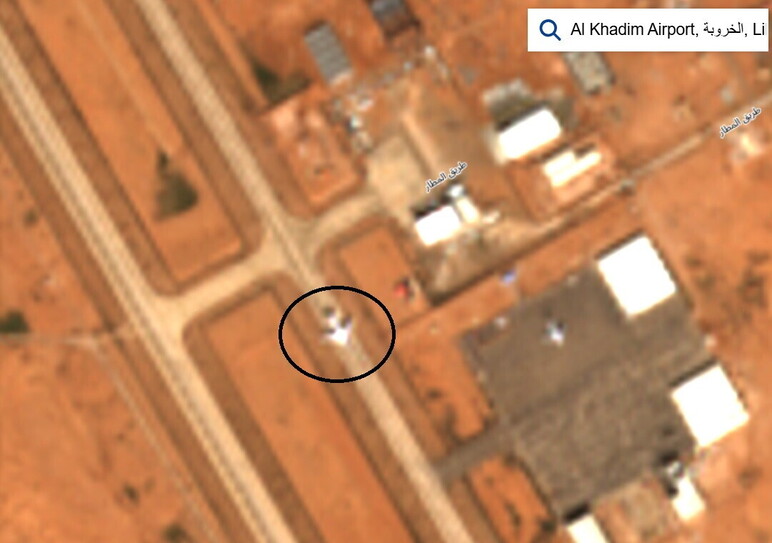
The Antonov stopped in Syria on the night of December 4 at the Russian base of Hmeimim in Latakia, and after three hours took off again toward Libya. The transponder was switched off, as Russians often do with these large transport aircraft, but the route indicates that the plane landed near Benghazi, at the Russian air base of al-Khadim. Satellite images show the An-124 on the runway of the Libyan airport (see image below).
There is no record of movements in the immediately following days, but on December 7 the RA-82037 briefly reappeared with its transponder on while flying over Burkina Faso, a few hundred kilometers west of Niamey, likely heading toward Bamako, Mali. The following day, again only briefly, the aircraft’s satellite signal showed it once more over Burkina Faso on the return journey. Also on December 8, the Antonov again flew from Libya to Burkina Faso. Further satellite images show the aircraft back at the Libyan base on December 10. “What’s unusual is not the route—these stopovers between Moscow and Bamako are frequent, though hidden by switched-off transponders. What’s anomalous is the frenzy of these flights, which is unusual,” explains an OSINT expert who has long tracked Russian Antonov flights in the Sahel. Intelligence sources cited by Il Foglio say that during the vast black holes along its route between Mali and Libya, the aircraft stopped in Niamey several times to load uranium. Each time, after the Libyan stopover, the plane also refueled in Latakia, Syria, before continuing toward Russia. “These aircraft have a maximum range of about 5,000 kilometers, so they must make several stops on such long journeys between Russia and the Sahel. But we don’t know whether the uranium was unloaded at some point during these stops or whether it was all transported to Russia,” the source says. It is not certain that the entire uranium cargo in Niamey is destined for air transport, and it cannot be ruled out that part of the convoy may continue toward Togo. Yesterday morning, the Matros Shevchenko finally docked again in Lomé. The reason remains a mystery.
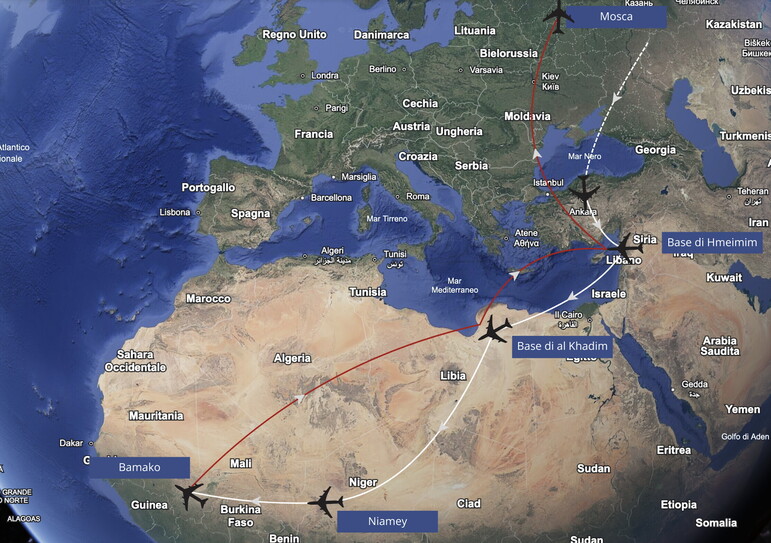
What is certain, however, is that the Russians are completing a very valuable transaction concluded last month with the Nigerien government, one of the world’s leading uranium producers. The Somaïr mine is theoretically controlled by the Société des Mines de l’Aïr, owned 63.4 percent by the French company Orano and 36.6 percent by the state of Niger. In June, after nationalizing the mining sector and removing it from French control, the coup junta had begun negotiations to sell the material to China or Iran. In the end, Russia’s Rosatom won the deal. France, however, contests the sale and claims control of the mines in Niger. Yesterday, the Paris prosecutor told Agence France-Presse that it had opened an investigation into organized theft in the service of the interests of a foreign power—namely Russia. As early as September, an international arbitration ruling had sided with the French and confirmed that ownership of the uranium belongs to them, not to the Nigeriens, who nevertheless proceeded with the sale, invoking “Niger’s legitimate right to dispose of its natural resources, to sell them to whoever wishes to buy them, according to market rules, in complete independence.” Beyond the danger posed by the cargo itself, what is alarming is Moscow’s ability to carry out such complex operations over such vast distances. Control of air bases located at calculated and non-random distances—such as al-Khadim or Hmeimim—is a major cause for concern for Europe as well, which finds itself facing a country like Libya that is not only the gateway to a region now contested between pro-Russian coup leaders and jihadists, but also effectively our own backyard. At present, it is occupied by Russians for trafficking in weapons, men, and now uranium as well.