
Esteri
The heaviest burden •
A test of governance in Iraq amid an open war in the region
As tensions between Iran, the United States and Israel pull Iraq deeper into an undeclared battlefield, the kidnapping of journalist Shelly Kittleson underscores how militias are turning the country into a pressure arena – testing both the state’s sovereignty and the limits of its next government
As military escalation between Iran on one side and the United States and Israel on the other gathers pace, Iraq once again finds itself at the heart of a deeply intricate regional equation in which geography intersects with politics and influence with sovereignty. The Iraqi scene is no longer detached from its surroundings; it has become a direct extension of an open conflict whose contours are drawn beyond the country's borders as much as they are shaped from within. It is against this tense backdrop that Iraq approaches its political milestones following the parliamentary elections held on 11 November 2025. Voter turnout reached 56 percent, the highest figure recorded since 2018, and the Shia Coordination Framework emerged at the head of the parliamentary scene with more than 187 seats. With the Federal Court ratifying the results and parliament convening its inaugural session on 29 December 2025, the constitutional path toward forming the new authority got under way through the election of the speakership, paving the road for the selection of the President of the Republic and the designation of the Prime Minister.
This constitutional process, however, is not unfolding under ordinary circumstances. It is taking place within a regional environment primed for ignition, where the prospect of a wider confrontation continues to grow and where Iraq's internal calculations are increasingly entangled with the agendas of regional and international powers. By virtue of its location and political composition, Iraq is hardly insulated from this conflict; in fact, it ranks among its most prominent undeclared theatres. Within this frame, the formation of the next government turns from a routine political requirement into a genuine sovereign test, one that will determine whether the Iraqi state can avoid being pulled into the axis of conflict or being reduced to an arena for the settling of accounts. The challenges awaiting the incoming government no longer stop at the economy and public services or even the file of unregulated weapons; they extend to the question of how to manage the balance between external pressures and internal stability at what is arguably the most dangerous regional moment in years.
A brief note on the Coordination Framework
By way of a concise introduction, the Shia Coordination Framework is a political bloc that brings together the bulk of Iraq's traditional Shia forces. It was constituted as a coordinating umbrella for managing shared positions inside parliament and beyond it, particularly during moments of crisis and major constitutional junctures. The Framework is not a single party or a classic electoral coalition but rather a vehicle of political understanding that gathers forces of varying backgrounds and weights, including those with armed wings and militias close to Iran or backed by it that entered political life after 2018. They have coalesced provisionally around one core objective: preventing the fragmentation of the Shia house and securing an influential presence in the equation of governance. The Framework took on its clearer contours after the early parliamentary elections of October 2021, specifically in the wake of the diminished representation of certain major Shia forces and the launch of the "national majority government" project championed at the time by the Sadrist movement in alliance with Mohammed al-Halbousi, leader of the Sunni Taqaddum party, and Masoud Barzani, leader of the Kurdistan Democratic Party.
As the political horizon closed in and the selection of a prime minister stalled, the Framework transformed in 2022 into a central player that steered the path of breaking the deadlock, ultimately producing the current government headed by Mohammed Shia al-Sudani. It is worth underlining here that the Coordination Framework effectively controls the present parliamentary majority following the November 2025 elections, which positions it to play a pivotal role in selecting the next prime minister and forming the next government according to the current distribution of seats inside the Iraqi Council of Representatives, while also exerting considerable leverage over every other political detail.
Naming the prime minister and the challenges that await him
With the designation of the prime minister drawing closer and names of potential candidates beginning to circulate, Iraq's political scene is entering one of its most sensitive and intricate phases. The matter goes well beyond settling on a name; it reflects fine-grained balances among the winning forces, calculations of consensus, pressures from the street and a tangle of economic, regional and international challenges. The next prime minister will not simply inherit an executive post but will shoulder a heavy legacy of accumulated crises ranging from the economy to the files of security and sovereignty, the Iraqi-Syrian relationship and the broader management of political and social pluralism within the system. In this context, the naming process becomes a real test of the Coordination Framework's ability to produce executive leadership capable of striking a balance between the demands of stability and the need to address structural dysfunction without sliding into the kind of disputes that would return the country to the square of deadlock.
The heaviest burden: the Iraqi economy and liquidity
This file sits at the top of the list of challenges. The next head of government will find himself confronting a complex equation: how to handle the financial squeeze that has gripped the government for months, how to secure the revenues needed to keep the state running and how to feed an enormous operational spending bill swollen by inflated payrolls, expanding non-investment public expenditure and the limited role of the private sector. Unemployment, particularly among young people and recent graduates, will remain a constant source of pressure on the government, carrying with it weighty economic, social and security consequences. All of this unfolds amid total reliance on oil revenues, weak economic diversification and a bloated administrative apparatus. The success of the next government will not hinge solely on the availability of cash but also on its ability to address the structural imbalances and accumulated problems plaguing Iraq's financial and economic system, a system that has long operated within a political environment that obstructs and indeed prevents any genuine reform capable of tackling the challenges affecting the very architecture of the economy and the mechanisms of its management.
Economist Ziad al-Hashimi argues in this regard that the combination of internal economic and financial pressures with current regional and international geopolitical shifts has created a new turning point laden with challenges to which the Iraqi political and economic establishment is unaccustomed. This may push it, by necessity rather than by choice, to accept solutions and economic approaches that were previously off the table because they cut across vested interests opposed to reform. According to al-Hashimi, this anticipated change in the political class's behaviour will inevitably make economic reform one of the priorities the incoming prime minister must champion and execute with competence in order to pull Iraq out of the financial bottleneck. He frames this as something that should be achieved with the lowest possible cost to the political establishment and its interests. The harsh financial reality currently facing Iraq, brought on by deteriorating revenues following the slump in oil prices, public spending swollen to historic levels and the expanding volume of public debt, calls for difficult and painful remedies. Any incoming prime minister will be forced to adopt sweeping and stringent measures aimed at curbing expenditure, maximising non-oil revenues and supporting all economic sectors so as to revive them after decades of paralysis.
Al-Hashimi closed his remarks by stressing that the quality of any reform programme depends in equal measure on the quality of the executive team behind it, beginning with the prime minister and extending through his cabinet and circle of advisors. The phase Iraq is passing through today is exceptional and requires an equally exceptional administration, one capable and competent enough to deliver a package of solutions of a kind never before implemented in the country.
It is worth recalling, in connection with this challenge, that there were squandered opportunities throughout the term of the outgoing government of Mohammed Shia al-Sudani, namely the substantial oil revenues and the financial surplus in the state's coffers from the start of that government's tenure through to mid-2024. That window made it possible to engineer an optimally managed financial environment that balanced operational costs with the funding of projects and the establishment of a sovereign wealth fund to absorb the surpluses generated by rising oil revenues, thereby creating diversified financial buffers to shield the economy during crises. None of that materialised. Instead, the government of the day moved to expand unnecessary public hiring and ramped up its current spending to unprecedented levels, which in turn drained the oil-driven surplus and turned the country from a state of plenty into one of financial distress, leaving behind a fiscal deficit, historic levels of debt and the risk of a possible default at any point during the coming year. That government has proved beyond any doubt that it failed, and the lesson is that opportunities do not always come along, and when they do come and are not seized as they should be, they do not merely slip away; they turn into yet another factor of stumbling and failure. That is precisely what happened with the Sudani government.
Iraq's marginal international role and the Iraqi-Syrian relationship
The Coordination Framework is currently weighing several names for the post of prime minister. According to senior figures within it, the discussion has centred on the need to factor in international and regional shifts, internal challenges (most notably economic ones) and the impact of political transformations on the Iraqi reality. This comes at a time when Iraq's role on the international stage remains limited and its external presence is often confined to protocol-level engagements, all while several sensitive regional files grow more tangled, foremost among them the relationship with the new Syrian regime and its president Ahmad al-Sharaa.
Against this backdrop, the ambition of the current prime minister Mohammed Shia al-Sudani to secure a second term has surfaced in earnest, opening the door to competition within the Framework and pushing former prime minister Nouri al-Maliki to declare his own candidacy in an attempt to block any renewal for al-Sudani. This sentiment is not confined to al-Maliki alone; a number of Framework leaders have made clear they do not wish to see al-Sudani granted a second term, for several reasons, chief among them his departure from the understandings reached when he was tasked with forming the government in 2022, particularly after he contested the 2025 elections at the head of his own political bloc.
Other names are also in circulation. Among them is Bassem al-Badri, head of the Accountability and Justice Commission, an institution whose name has at various points been bound up with its use as a tool for sidelining political opponents under headings related to affiliation with the Baath Party of the Saddam Hussein era. Also on the list of names being floated is Ali al-Shukri, a former member of parliament for Najaf Province, a former minister of planning and currently senior advisor to the President of the Republic. In parallel, the name of Hamid al-Shatri (the current head of Iraqi intelligence and former chief of the National Security Service) is also being mentioned, particularly in light of developments on the Syrian scene following the fall of Bashar al-Assad's regime. Iraq found itself at that moment on the cusp of a highly delicate phase that nearly triggered a regional incident, given the high-level political refusal to engage with the new Syrian reality or to accept it. Hamid al Shatri took on the task of managing communication with Damascus and laying the foundations of a new relationship anchored on the security file and border control. That phase witnessed moves aimed at containing the tensions and ordering the relationship with the new authority in a way consistent with the requirements of Iraqi national security, while imposing a more pragmatic approach to managing the changes.
On the shifts within the Syrian political structure, Vladimir van Wilgenburg, a Dutch journalist and researcher and co-author of the book "The Kurds of Northern Syria: Governance, Diversity and Conflicts," notes that there is no real trust in the new government in Damascus on the part of Baghdad, though it cannot be said that relations are severed. In the immediate aftermath of the fall of the Assad regime, Baghdad was particularly anxious about the file of border security. Syrian president Ahmad al-Sharaa did not attend the Arab summit hosted in Iraq, and the visit of the Syrian foreign minister was postponed despite an official invitation having been extended to him. The Shiaparties holding the parliamentary majority in Iraq are not at ease with the new administration in Syria. Even so, Iraqi prime minister Mohammed Shia al-Sudani has stated that his government is in talks to resume oil exports through Syrian territory. According to van Wilgenburg, whether to develop the relationship with Syria or to open horizons of cooperation across the board, or instead to confine it to the security framework alone, is a decision that rests with Iraq. Yet experience shows that security frameworks do not work on their own without parallel political tracks alongside them.
Vladimir adds that Syria is a significant neighbour for Iraq and that the absence of relations with it would generate genuine risks. Hamid al-Shatri, head of Iraqi intelligence, has visited Damascus at least twice and played a pivotal role in opening the first lines of communication between Baghdad and Damascus and in handling a number of important files with shrewd steps. Among the other files that matter to Baghdad is the file of Iraqis held in al-Hol camp, though that file does not necessarily require coordination with Damascus given that the camp falls under the control of the Syrian Democratic Forces. In contrast, border coordination remains a matter of considerable importance in the context of the fight against ISIS and in curbing the drug trade.
Iranian influence and the oolitical engagement of Iraqi militias
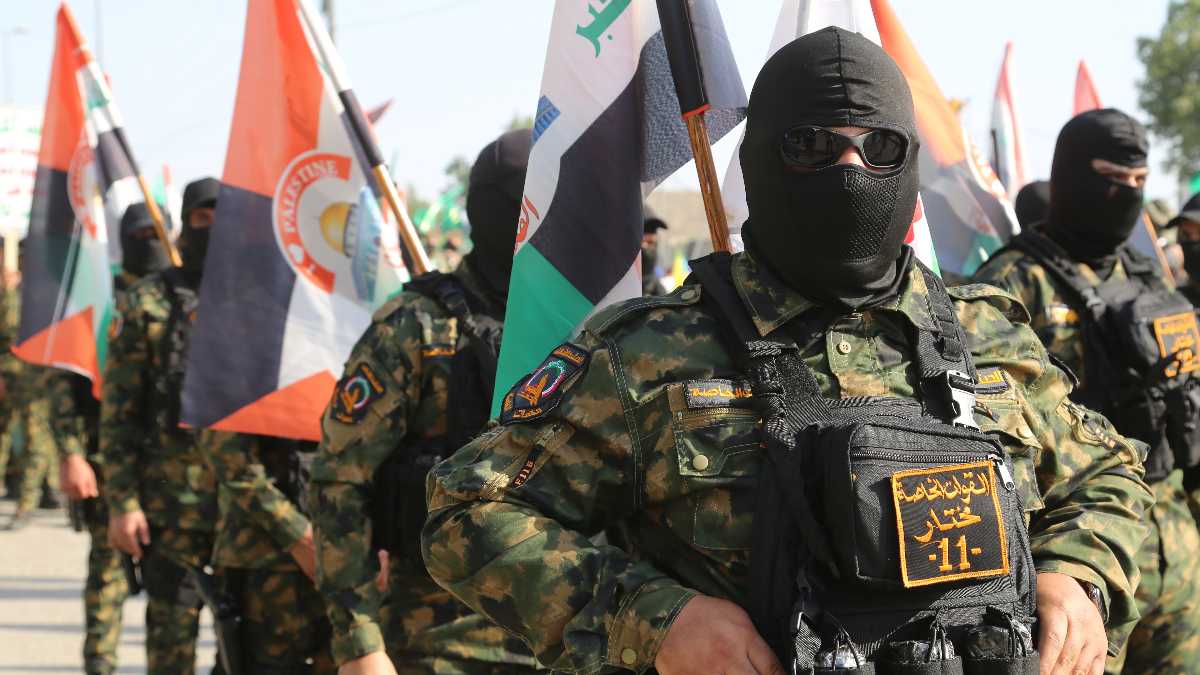
As the escalation between Iran on one side and the United States and Israel on the other accelerates, the file of Iranian influence in Iraq has returned to the forefront as one of Tehran's most important instruments for managing this conflict. Iraq is no longer merely a traditional sphere of influence; it has become a vital space through which messages of pressure and indirect escalation are conveyed. Iran in this context relies on a network of armed factions built up over years through military and logistical support and through the deepening of doctrinal and organisational ties. These factions are no longer mere combat formations; they have become part of a broader regional system based on the principle of "managing the conflict by proxy," which gives Tehran the ability to manoeuvre and to extend its influence without being drawn into a direct and all-out confrontation. As regional tensions mount, the role of these factions becomes more pronounced, whether through threats to target American interests, through raising the level of military readiness or even through the use of unconventional pressure tools such as kidnappings and media escalation within the broader context of mutual pressure. This reflects a shift in these groups from a local role to that of a regional actor tied to the rhythm of the wider conflict.
In this context, the kidnapping of American journalist Shelly Kittleson stands out as confirmation of the use of pressure tools. What is striking here is not only the nature of the operation but the timing as well. It comes against the backdrop of ongoing tensions between the armed factions and the American presence, which lends weight to the hypothesis that the abduction is part of a layered message: a security squeeze, a political signal and a test of the government's reaction. On the political level, these factions continue to entrench their influence through party arms and parliamentary blocs that participate actively in the political process, which gives them direct leverage over legislation, the formation of governments and the distribution of posts. This political presence cannot, however, be separated from their armed strength; the two are complementary. That force is wielded as an unspoken pressure tool that bolsters their negotiating position and frequently grants them weight that exceeds their actual electoral footprint.
The results of the recent elections laid bare this overlap between weapons and politics. Forces and factions tied to this axis managed to achieve a notable parliamentary presence, allowing them to project broader influence within state institutions. The Asaib Ahl al-Haq movement, for example, won 29 seats, while Kataib Sayyid al-Shuhada took 7 seats. Falih al-Fayyadh, head of the Popular Mobilisation Commission, ran within the alliance of prime minister Mohammed Shia al-Sudani and secured 9 of the 45 seats won by that alliance. Iranian influence in Iraq is no longer confined to the security dimension; it has become an integrated system that combines armed action with political clout and moves with considerable flexibility according to the shifts in the regional conflict. With tensions persisting between Iran and its adversaries, Iraq is expected to remain a central arena for this rivalry, with all the direct repercussions this carries for the stability and internal balance of the state.
In this connection, Dr Ihsan al-Shammari, head of the Political Thinking Centre, takes the view that this transformation of the factions into a political asset is not the product of popular acceptance so much as it indicates that these factions have, since 2018, embedded themselves within state institutions and seized a considerable degree of control over their trajectories. That control has given them a grip on many of the sources of decision-making, which can in turn be converted into electoral capital alongside the political capital they already command. From a different angle, al-Shammari observes that the armed forces possess a sizeable financial arsenal that has enabled them to win further followers and, more importantly, more voters, especially given that the 2025 elections were, in his words, elections of money and vote-buying. Furthermore, the withdrawal of the Sadrist movement gave these factions greater capacity to fill the Shia vacuum specifically, and that is what has lifted their political fortunes.
Dr al-Shammari believes that the retreat of what are known as the resistance factions from their previously stated positions in favour of confining weapons to the hands of the state is part of a manoeuvre adopted by the armed factions in an attempt to buy time and to compel the United States to grant them space, thereby allowing these factions to achieve their objectives. It would appear that the United States is convinced it does not wish to be drawn into a conflict inside Iraq, which is why it is escalating its rhetoric instead.
This position, as far as the factions' coordinating body is concerned, is directly tied to a vision that runs from Tehran to Baghdad and on to the southern suburb of Beirut, in reference to Hezbollah. It would seem that the agreement, or what remains of what is called the axis of resistance, rests on the principle of not handing over weapons. That is why these factions moved swiftly to walk back the issue of confining arms to the state, in line with this Iranian vision, al-Shammari said. He added that the rejection came after the statements made by the prime minister and the head of the Supreme Judicial Council, but that it is also tied to the nature of recent developments, including the possibility of a renewed war between Tel Aviv and Tehran. From another angle, the operation to detain the Venezuelan president sent a clear message to the factions, namely that disarming may not guarantee their survival or their continued presence on the political scene. They are therefore raising the ceiling in order to obtain greater guarantees. He also rejects any characterisation of the Iranian role in Iraq as being in retreat, given that Iraq is the last fortified wall for Iran, geographically, politically and economically. For this reason, Iran has shifted its strategy to follow what might be termed a strategy of silent grip. The reason, as Dr al-Shammari describes it, is that the Islamic Republic does not wish to provoke the United States in Iraq and is also keen to convey the impression that it has grown weaker, which runs contrary to the actual reality. Iran wants to control the scene through what may be called dark rooms, away from the eyes of the United States.
Iran therefore continues to wield very considerable control, and its allies still have the ability to shape decisions, especially given that the presence of close to one hundred and five parliamentary seats belonging to armed factions loyal to Iran underscores its weight and the durability of its alliance with these groups in defence of its interests. This brings us back to the issue of confining weapons to the state. Iran may push toward integrating some of the factions into state forces or arriving at arrangements regarding heavy weaponry as part of a tactical decision and a transitional phase, until US president Trump's term ends. This gives us a clear indication that there is no change in the regional strategy of the Islamic Republic.
From another perspective, the political affairs researcher Raad Hashim takes the view that the post-election political reality in Iraq is one in which the armed and factional forces have become a principal actor that cannot be ignored, with the Shia Coordination Framework forming the backbone of this influence. Although the international community, and chiefly the United States and the Western states, prefers to deal with the government and its official façades, the influence of the factional forces over those façades has become plain to see, to the point that any incoming cabinet or political configuration that fails to take the Framework's interests into account may face direct or indirect pressure. International engagement, accordingly, will always operate within the bounds of the "facts on the ground," where the real actor is the one who possesses the ability to influence rather than the one who merely occupies the official seat.
On the Coordination Framework's role, Hashim sees it as more strategic and more cautious than it lets on. The Framework does not stop at heeding international or regional pressures; it works to preserve its dominance by balancing between Iran and the United States, though usually in a manner that serves its own interests and political agenda. Its strategies include taking hold of the key ministries, managing internal alliances and trying to keep the armed factions quiet and away from resorting to weapons. The Framework's core objective is not merely to participate in government but to consolidate its influence and ensure the continuity of Shia rule in a way that secures its grip on political decision-making within the democratic track.
As for the durability of its hold on power, Raad Hashim believes the Coordination Framework relies on clear political dominance while bringing in the other components according to their electoral weight in order to avoid direct friction or international criticism, all while managing sensitive files in a way that serves its interests. The Framework also makes use of pressure tools, selective concessions and at times surface-level balances in order to maintain its political stability, ensuring its capacity to impose its policy and will on the government and parliament and to deliver on its long-term objectives without surrendering its position as a principal player on the Iraqi scene.
In a related vein, Ziad Tariq, the secretary general of the Watan Civil Iraqi Gathering (an active political party on the Iraqi scene), said that Iraq is going through a sensitive and delicate phase marked by accumulated economic and livelihood challenges, against a backdrop of continually rising taxes and a marked decline in the standard of living of the average Iraqi. All of this is exacerbating public anxiety and placing the next government before a real test. Tariq pointed out that addressing these crises now hinges principally on achieving political stability and forming a government capable of managing the regional and international balances, particularly with regard to the nature and shape of the relationship between the United States and the Islamic Republic of Iran, in a way that safeguards Iraqi interests and prevents the spillover of the external conflict into the country's interior.
He added that the forces of the Coordination Framework must (and this is non-negotiable) place the supreme national interest above narrow personal and ideological interests. He considers that the current phase may well represent one of the last decisive opportunities to set the course of the Iraqi state, either toward continuing in power along a path of moderation, balance and responsible national politics, or sliding into chaos and collapse in the event that the political deadlock persists and sovereign decision-making remains weak. He closed with a warning that any failure to capitalise on this political moment could weigh negatively on the public's confidence in the political system as a whole and open the door to further economic and social complications. In sum, the next Iraqi government will stand before a real test of governance unlike anything that came before, a test measured not by the number of seats or the size of political consensus but by the ability to manage complexity: the complexity of an exhausted economy, the clash of regional interests, the conflict of unregulated weapons, the limits of foreign influence and the erosion of public trust in the state and its institutions.
The Coordination Framework, as the most influential bloc in the current equation of governance, bears the greater share of responsibility in shaping the direction of the next phase. It will either succeed in producing a government endowed with a minimum of independence, competence and the capacity to balance internal and external considerations, or it will turn into a force that entrenches the crises by recycling the same system and the same methods that brought the country to this critical juncture.
Continuing to manage the state with the mindset of temporary settlements and giving the logic of force precedence over the logic of the state will leave any incoming government as little more than a crisis-management cabinet rather than a government of solutions, and will keep Iraq hostage to economic fragility and to the tug of regional polarisation. Breaking this cycle requires a brave political decision and a real will to place the national interest above factional and ideological calculations, and to move from the logic of influence to the logic of statehood.
In the end, the next Iraqi government will not face a conventional test that can be navigated through the usual political settlements but a defining moment in which the state's ability to remain outside the regional fire (or to be drawn into it) will be measured. The war now under way is no longer a distant event that can be neutralised; it has become a pressing reality that is reshaping the balances and forcing on Baghdad choices that have not previously been laid out with such clarity. The challenge is no longer simply that of managing an exhausted economy or reining in unregulated weapons but of charting Iraq's place within an open conflict in which international wills intersect with the calculations of local powers. Any miscalculation or attempt to escape forward through fragile settlements may this time produce not merely a political deadlock but a higher cost that touches general stability and places the state before unprecedented security and sovereignty tests.
The Coordination Framework, as the most influential force, is not facing today only the test of forming a government but the test of its ability to move from the logic of managing influence to the logic of managing the state, and from calculations of dominance to calculations of survival. Insistence on reproducing the same equations within an explosive regional environment may turn any incoming government into a powerless façade in front of realities imposed on it from both abroad and at home. Within this complex equation, the question grows sharper than ever before: do Iraq's political forces have the capacity to keep the country out of a conflict that overshadows them, or will the next government, willingly or otherwise, become part of that confrontation? The answer will not be written in statements of consensus but in how the government handles the first real test that this war imposes on the ground.
* * *
Ali al Mikdam is a researcher specializing in Iraqi political conflicts, regional influences, and social change. He has contributed to numerous Arab and international publications, focusing on Iraqi politics, regional dynamics, and the role of armed groups in Iraq. His X account @ali_almikdam