
World
The photos •
What is happening in France with the student protests
From Paris to Lille and on to Marseille, over the past week and across the country, secondary school pupils have been demonstrating to demand more resources for education. Around two thousand people have been arrested, with 170 pupils and 65 members of staff injured, including 40 headteachers. Today, four hundred schools will be closed. Interior Minister Nunez: “Urban violence”
Around four hundred secondary schools have been closed by the authorities, with remote learning taking place in many institutions and bans on demonstrations outside the schools concerned. A year after the protests by the ‘Bloquons tout’ movement, and just a few months after the demonstrations over pension reform, France is facing a new wave of tensions linked to student protests demanding greater investment in education and denouncing the deterioration of schools, overcrowded classrooms, a shortage of teachers and excessively demanding timetables. The Minister of the Interior, Laurent Nunez, who last night convened a meeting with prefects, senior police and gendarmerie officials, and heads of the intelligence services, spoke of “a worsening of the situation that no longer has anything to do with the legitimate expression of secondary school pupils’ demands, but now exhibits all the hallmarks of a situation of urban violence”. As announced by the Minister for Education, Édouard Geffray – who is due to meet today with trade unions, secondary school pupils’ associations, parents and student representatives in an attempt to reopen dialogue – forty headteachers have been injured since the start of the demonstrations: “To date, we have had 65 members of staff injured, including 40 headteachers, and 170 pupils. Over a hundred secondary schools have suffered serious damage.”
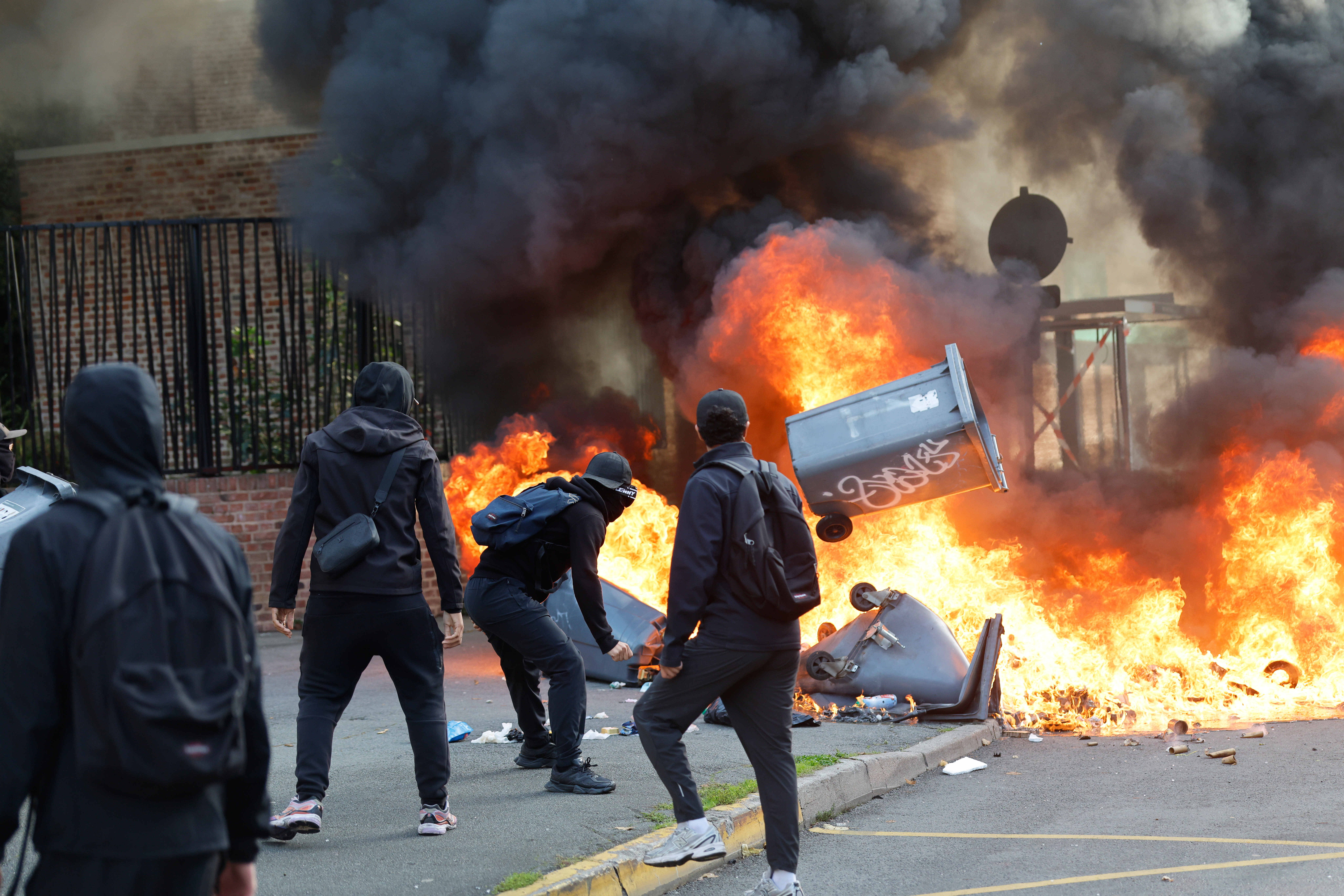
Protests broke out last week in schools across the Paris region of Île-de-France and subsequently spread throughout the country, eventually involving university campuses as well (around thirty, according to the students’ union, across Paris, Strasbourg, Marseille, Lyon 2, Reims, Poitiers and Nanterre). According to the authorities, 900 incidents were recorded yesterday outside secondary schools, with the protests spreading to all French departments, and nearly 2,000 people were detained, “90 per cent of whom were minors”, Justice Minister Gérald Darmanin specified, – figures that come on top of nearly another thousand from recent days – with over 300 police officers and gendarmes injured. A political row immediately flared up in a France that will be voting in seven months’ time to choose Emmanuel Macron’s successor. At the start of the demonstrations, Prime Minister Sébastien Lecornu denounced on X an “irresponsible” attitude on the part of La France Insoumise; the radical left-wing party is accused by the head of government of “exploiting” the students’ anger. The party leader, Jean-Luc Mélenchon, responded immediately, accusing Lecornu of having “ordered the crackdown” on the protests. This accusation was also echoed by Marine Le Pen’s Rassemblement National, which is leading in the polls ahead of the presidential race. According to sources at Matignon, the intelligence services believe that the movement to block access to secondary schools is a “manoeuvre orchestrated” by LFI “and its far-left allies”.
Announcing the closure of around four hundred of France’s 3,700 secondary schools, Minister Geffray emphasised: “The first priority is to protect our pupils.” He then appealed to families: “Do not let your children go to school in such circumstances.” Minister Darmanin has asked public prosecutors to hold parents civillly liable for damage caused by their children during the secondary school blockade, so that they are the ones to "pay for the repairs". Prefects have banned demonstrations today near closed secondary schools. In Paris, the measure affects thirteen schools. In an attempt to ease tensions, the government has abandoned plans to introduce enrolment fees for BTS higher technical courses and for preparatory classes for the grandes écoles – a measure contained in the 2027 draft budget presented yesterday and contested by the left and various trade unions. According to the Ministry of the Interior, the mobilisation on 1 October involved a total of 1,027 schools, with 222 blockades.

The situation was particularly tense in Marseille, where, at the Lycée Victor Hugo, the headteacher and his staff were attacked inside the school and doused with petrol. Also in France’s second city, a fire engine was set alight. In Rennes, Brittany, early this morning, a number of students – some hooded and dressed in black – gathered outside the Lycée Jean Macè, which was under heavy police guard. Fires broke out outside a school in Rouen, Normandy, where two headteachers were injured. Meanwhile, images of the flames at the Lycée Mandela in Nantes have been circulating online. Another headteacher, at the Lycée Dregrugillier in Auchel, near Béthune in Pas-de-Calais, was struck by a firework mortar rocket and taken to hospital. Student organisations are calling for the protests to continue ahead of a major demonstration on Tuesday.