
•
A UN report exposes the failures of Operation IRINI on arms trafficking in Libya
The United Nations experts confirms the investigation by Il Foglio: a shipment of armored vehicles from the United Arab Emirates was delivered to Misurata and Benghazi through the European mission. The beneficiaries were a militia accused of human rights violations. The role of Ahmed Gadalla, the trafficker linked to Saddam Haftar
di
22 APR 26
Ultimo aggiornamento: 07:34 AM

EunavforMed Facebook Page
The report released on Monday by the United Nations Security Council Panel of Experts confirms the investigation by Il Foglio, published in August last year, which exposed a trafficking operation involving weapons and fuel between the United Arab Emirates and Libya aboard a cargo vessel named Aya 1. At the head of this smuggling network, which violates the UN embargo, is Ahmed Alushibe, also known as Ahmed Gadalla, a wealthy businessman from Benghazi active in Dubai and close to Saddam Haftar, deputy commander general and son of General Khalifa Haftar. Gadalla has always rejected all accusations, but within a few months he could be subjected to economic sanctions.
The consequences could be significant for Gadalla’s business activities, which until two months ago still included in his extensive investment portfolio a feasibility study with the Italian company Saipem for the construction of Libya’s first private refinery. The repercussions will also be important for the Haftar family, who had relied on the Benghazi-based businessman to obtain weapons and other benefits through a network of trafficking between Libya and the UAE, a backer of eastern Libya’s government.
The investigation conducted by the UN Panel of Experts shows that violations of the embargo in Libya are ongoing and involve both domestic and foreign actors. In the case of the Aya 1, the UN document also levels very serious accusations against the European Union’s naval mission Operation IRINI, which, with a budget of over €16 million and a mandate expiring in March next year, has among its main objectives the monitoring of compliance with the embargo in Libya. According to the report, the operation “failed to implement its mandate” in relation to the Aya 1, “did not take the necessary measures to identify the military matériel” on board, and did not stop the arms trafficking. This serious “oversight” ended up benefiting, among others, a militia accused by the UN of human rights violations, Katiba 55, as well as—according to Il Foglio—the Rapid Support Forces, responsible for crimes against humanity in Darfur and the final recipients of the armored pickup trucks.
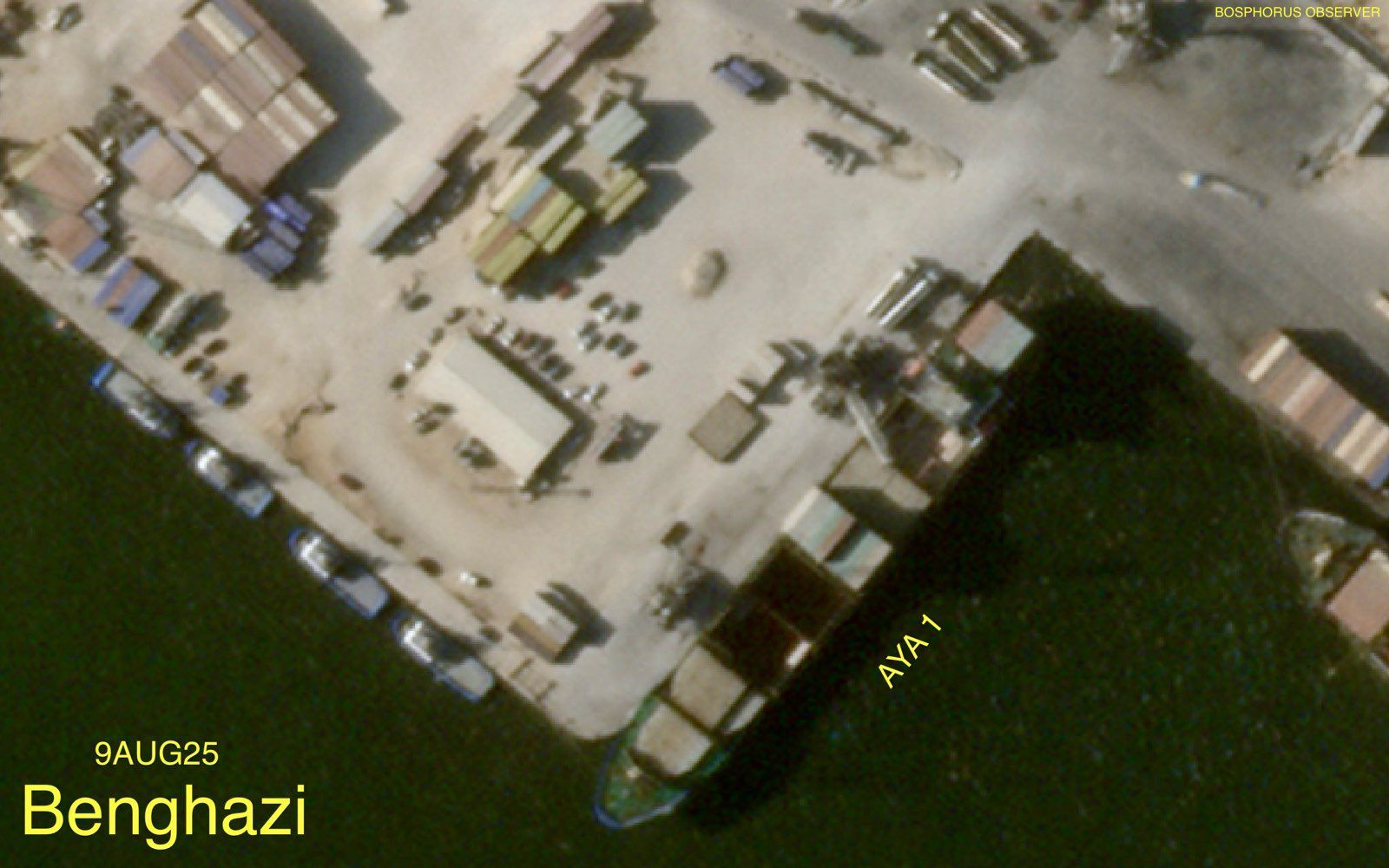
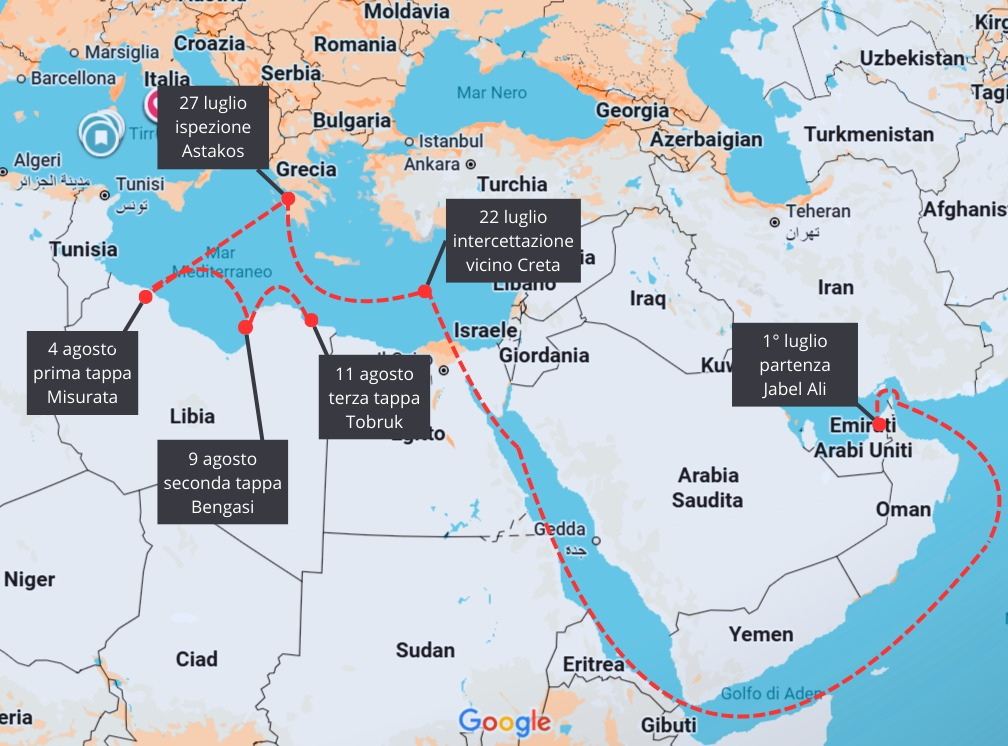
The investigation published last year revealed that the container ship Aya 1, which departed from the Emirati port of Jebel Ali on July 1 and was bound for Benghazi, had been stopped for inspection in the Mediterranean off Derna by frigates from the EU mission Operation IRINI—one Greek and one Italian—following a tip-off from U.S. intelligence. The vessel belonged—and still belongs, albeit under a different name, Zulfa 1, adopted shortly after our investigation was published—to UDS Shipping Services LLC, owned by Ahmed Alushibe.
On July 27, the Aya 1 was taken to the Greek port of Astakos for inspection. According to Greek media, the ship officially declared it was carrying “cosmetics, cigarettes, and electronic equipment.” Gadalla himself, contacted by phone by Il Foglio, had stated that the vessel was not transporting any weapons. However, the UN report now confirms that a total of 240 pickup trucks were identified on board, 86 of them armored, destined for Libya. These were various Toyota models, typically used for mounting machine guns and favored by Libyan and Sudanese militias. The UN defines these pickups as “military equipment,” the delivery of which constitutes a violation of the embargo.
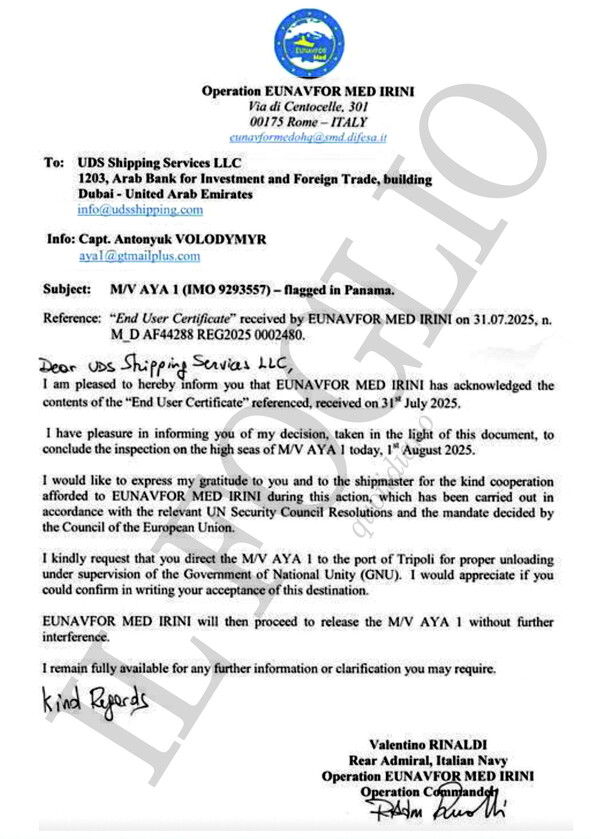
And this is where the role of Operation IRINI becomes unclear. Despite these weapons having been discovered on board, the Aya 1 was authorized by the European mission to resume its voyage as if nothing had happened. Il Foglio had published a letter signed by the then mission commander, Italian Rear Admiral Valentino Rinaldi, thanking the ship’s captain and owner for their “kind cooperation” during the inspection.
The letter, addressed to UDS Shipping Services LLC, had been provided directly to us by Ahmed Alushibe, who intended to use it to demonstrate his innocence, but which instead pointed to his direct responsibility for the Aya 1. In the letter, IRINI did not state at any point that there were no weapons on board, but rather requested that the vessel proceed to Tripoli, the seat of the only Libyan government recognized by the international community.
We had asked the European Commission—which, through the European External Action Service, oversees IRINI—for clarification as to why the ship had been allowed to continue its journey, despite the discovery of military equipment on board. A spokesperson replied in writing, stating that the vessel had been allowed to proceed “in accordance with the exemptions to the United Nations arms embargo.”
Such exemptions to the embargo on Libya do indeed exist. However, in their report, the UN experts contradict the EU’s account: “No request for exemption from the arms embargo had been approved prior to the transfer. Therefore, the transfer was carried out in violation of paragraph 9 of Resolution 1970 (2011).”
In short, a ship carrying “military equipment” was allowed to reach its destination by the European mission which, instead of enforcing the embargo, put forward unfounded justifications in order to let it proceed.
But there is more. According to Il Foglio’s reconstruction, the decision to allow the vessel to depart again was the result of lengthy, secret negotiations involving Brussels, the Greek government led by Prime Minister Kyriakos Mitsotakis, the United Arab Emirates, and the Libyan authorities in both the east and west of the country. Concerned about the exceptional flow of migrants leaving Libya and heading toward the coast of Crete, Greece sought to avoid offending the Haftar camp and, to prevent possible retaliation, opted for what it saw as the lesser evil: reporting to the United Nations through Operation IRINI while still allowing the delivery to go ahead.
Contrary to instructions, the Aya 1 did not unload its cargo in Tripoli but in Misurata, where it docked on August 4. As reported by the UN document and anticipated by our investigation, part of the illegal cargo was unloaded there following an explicit written request by Tripoli’s prime minister, Abdulhamid Dabaiba, dated May 6, though the experts highlighted several irregularities regarding the intended recipients. A total of 209 vehicles were offloaded in Misurata, while the rest of the cargo was nevertheless delivered to Benghazi on August 7, in violation of European instructions.
Of those unloaded in Misurata, the UN report explains that 26 vehicles ended up with Katiba 55, “an armed group based in Warshefana that has violated international human rights law at the detention center in al Maya.” Al Maya is one of the most notorious prisons in the country for the detention of migrants and for the abuses they have reportedly suffered there.
In addition to arms trafficking, the Panel also confirmed the part of Il Foglio’s investigation concerning Gadalla’s role in the smuggling of diesel fuel from Libya to the United Arab Emirates. The Aya 1 was again involved in an illegal diesel shipment last March from Tobruk to the UAE, which we had documented with photographic evidence. According to the Panel, the transport was carried out using flexible bladders hidden inside 22 containers. In this case as well, Ahmed Alushibe denied all allegations.
Di più su questi argomenti:
Sono nato a Latina nel 1985. Sangue siciliano. Per dimenticare Littoria sono fuggito a Venezia per giocare a fare il marinaio alla scuola militare "Morosini". Laurea in Scienze internazionali e diplomatiche a Gorizia. Ho vissuto a Damasco per studiare arabo. Nel 2012 sono andato in Egitto e ho iniziato a scrivere di Medio Oriente e immigrazione come freelance. Dal 2014 lavoro al Foglio.