
Esteri
Interview •
Exclusive. María Corina Machado: "Venezuela will be free. It is time to set a date for elections"
From the reforms imposed by interim president Delcy Rodríguez, to the possible return to Caracas and Trump's foreign policy - and his clash with Pope Leo XIV. The 2025 Nobel Peace Prize speaks to Il Foglio after meeting Italy's PM Giorgia Meloni in Rome
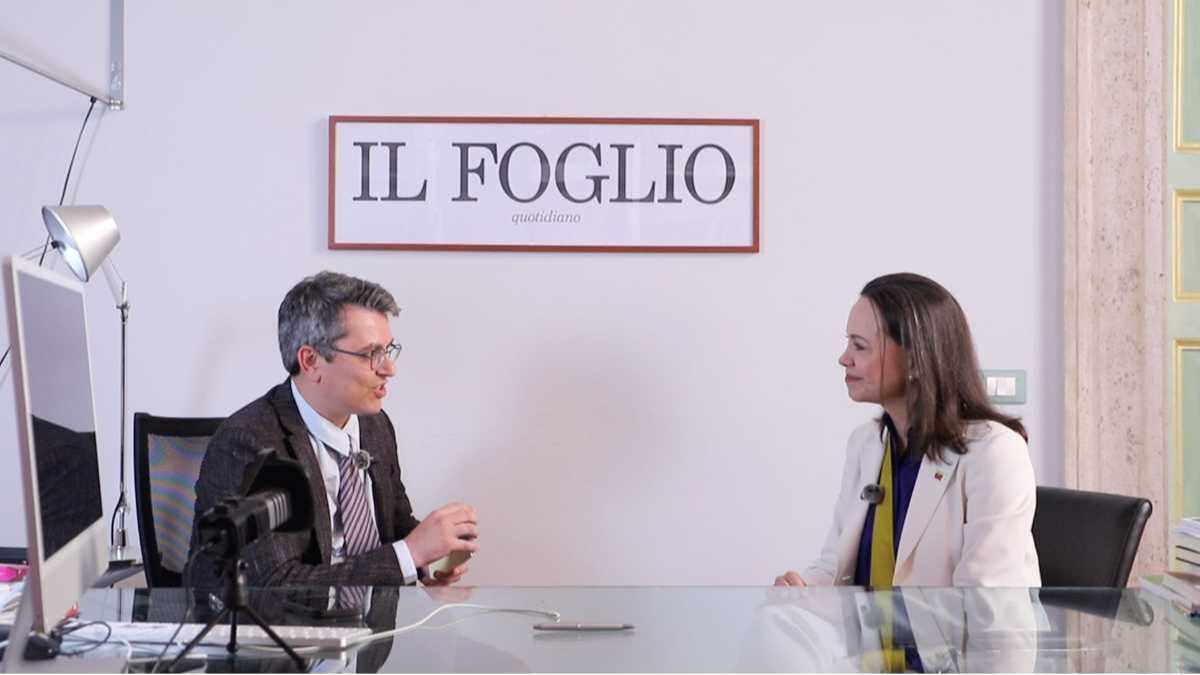
María Corina Machado, leader of Venezuela's democratic opposition, spoke to Il Foglio after meeting Italian Prime Minister Giorgia Meloni. The conversation covered the still critical situation in her country, the progress on civil rights since the U.S. military intervention that led to the arrest of dictator Nicolás Maduro, the reforms carried out by interim president Delcy Rodríguez in an effort to keep the regime afloat, Donald Trump's foreign policy and his confrontation with Pope Leo XIV, and the road ahead toward democratic transition. During her visit to Il Foglio's newsroom, the Nobel Peace Prize laureate comes across as warm and optimistic, even visibly enthusiastic about Venezuela's future despite the gravity of the situation. She announces her return to Caracas - without saying when - and declares that the time has come to prepare for elections: "It is time to move toward an electoral calendar so that Venezuela can finally have the free and fair elections it has not had in twenty years".
Machado is on an institutional tour of Europe. She has been to the Netherlands, France, and Italy, meeting the heads of government Rob Jetten, Emmanuel Macron, and Meloni. Today she is in Spain, though she will not be meeting Prime Minister Pedro Sánchez - "this is not the right moment" she says. Relations between Spain's socialists and the Venezuelan opposition have long been strained, not least because of former prime minister Zapatero's closeness to the regime. With Meloni, on the other hand, relations are warm: "I told her - and I want to say this to all Italians - how grateful we are for the enormous support we have received over all these years. There are deep ties between our two nations. Thousands upon thousands of Italians found a new home in Venezuela over the decades. And many Venezuelans have come to Italy because of the terrible conditions in our country. I thanked her for her support for the Venezuelan people and for the way she defends Western values in these difficult times".
When Machado fled Venezuela in December 2025 to collect the Nobel Prize, Maduro was still in firm control. Just weeks later, on January 3, the United States arrested the dictator in a swift operation and brought him before a court in New York. A little over a hundred days have passed since then, and power now rests with his vice president, Delcy Rodríguez. The question is whether anything has truly changed. "Venezuela has changed significantly", Machado says.
"Of course, a criminal regime is still in power, and the state of democratic institutions remains unchanged. Our country ranks dead last in the global rule-of-law index - 143rd out of 143 countries. But these processes take time: rebuilding democratic institutions, reclaiming control of the territory, driving out the criminal networks, including agents of the Russian and Iranian regimes, and groups like Hezbollah and Hamas that operate freely inside Venezuela. That is why it takes time". But it does not mean that everything is the same as before. "In terms of democracy and freedom, we are beginning to see signs that people are reclaiming their space. They are starting to gather - first in churches, then within prison walls, then in the streets and universities. For the first time in months and months of terror, people are going out and speaking their minds again".
Under pressure from the Trump administration, Delcy Rodríguez has enacted two reforms that would have been unthinkable until recently in the history of the Chavista regime: an amnesty that freed many political prisoners, and a new hydrocarbons law that opened the country's devastated oil sector to private and foreign investment. But Rodríguez's is not a genuine or independent reforming impulse, Machado insists. "Everything she has done was because she was forced to — not because she wants to open Venezuela or bring democracy to the country. On January 3 they were defeated. It was a clear signal that justice would reach Venezuela. Step by step, they have begun dismantling the repressive, corrupt, and criminal apparatus. We are witnessing very important developments: more than 600 political prisoners have been released. But 485 are still behind bars. The amnesty has been applied in an entirely arbitrary fashion - they grant it to whomever they choose, with no explanation. These are the first steps in taking apart the repressive structure, and people can already feel it. It is like a great dam full of energy where a small crack has opened. There is no going back. People are determined to live in freedom, determined to see justice done. We want our children to come home".
A crucial question is when Machado herself will be able to go back home - and under what conditions: in freedom and with full political rights, or facing the threat of arrest, since the amnesty excludes certain charges that regime figures have levelled against her. "I have been accused of everything by the regime", Machado says, "because we mobilized and united a country for freedom, for democracy, for our families, for our children. But the regime is not afraid of me - it is afraid of the people. They know Venezuelans are no longer divided. They are united. There is perhaps no other country in the region, maybe in the world, as cohesive as Venezuelan society is today. More than 80 per cent of Venezuelans want the same thing: for this criminal regime to go, so we can work hard to build a nation that lives in peace, justice, and opportunity for all. Around 9 million Venezuelans have been forced to flee the country. Most of them want to come back. Even here in Italy, I have met people in the street who tell me, in tears, 'I want to go home.' But they will not return as long as the same criminals who persecuted and tortured them are still in charge. So we must press forward. I know they threaten me, that if I go back they will come after me - but in the end it is my duty, my responsibility, to walk alongside our people in this final chapter of a very long struggle." Machado, however, is not yet ready to name a date for her return. "Venezuela will be free and I will be home very soon — as soon as I have accomplished the goals I set for myself when I decided to leave the country, at enormous personal risk. For more than twelve years I had been barred from leaving. I wanted to meet people with vision — world leaders in politics, media, business, finance, culture, and academia. People like Giorgia Meloni, who represents a point of reference for the values we share. Once I have fulfilled these objectives, I will return home".
Machado's return is, inevitably, a political event that must be negotiated with both Washington and Caracas - which means that some channel of dialogue with the regime is necessary. "We receive a great deal of information from people who contact us, people close to the regime who understand that this process is irreversible. They know we will never give up until we have full democracy and full freedom. But we have not been in direct contact with those now in power - not about my return, not about anything".
U.S. Secretary of State Marco Rubio, with whom Machado has a close political relationship, has laid out a three-phase framework for Venezuela. Stabilization, which has already been achieved. Economic recovery, which is underway - oil production has risen and the IMF projects 4 per cent GDP growth this year. And finally, democratic transition, though it remains unclear when that will come: under this U.S. administration or the next. "As the Secretary of State has said, these three phases are not sequential - they can overlap. A few days ago Rubio said the first phase is complete, the second is in progress, and it has both an economic recovery dimension and a democratic reconstruction dimension. And that is already happening: political prisoners are being released, journalists are beginning to report on what is really going on in the country, and people are taking to the streets. In the last week alone we have had more than 150 public events with hundreds of people gathering together. That would have been unthinkable a few months ago. So now is the time to move toward an electoral calendar, to finally have the free and fair elections we have not had in twenty years. We need a new electoral council, and we need to give Venezuelans living abroad the chance to register to vote. That will take some months, but we must start right away".
It seems, though, that Trump is perfectly comfortable with Delcy Rodríguez in power, carrying out his directives. The risk is that the White House may be content with the status quo and let democratic transition slip into the indefinite future. "But this situation is unsustainable", the Venezuelan Nobel laureate replies, "because more than 80 per cent of the population wants to live in freedom and wants its will respected. We had an election in 2024 that we won overwhelmingly. And yet 86 per cent of the population lives in poverty - in a country with the largest oil reserves on Earth. Our children go to school only twice a week because teachers are paid a dollar a day. This cannot last. Venezuela's energy potential alone requires investment of more than 150 billion dollars. What oil company is going to put billions into a country where the rule of law does not exist?".
In a widely debated gesture, Machado had chosen to donate her Nobel Peace Prize gold medal to Donald Trump, in recognition of his role in removing Maduro from power. But after the war in Iran, does Trump still deserve that tribute? Machado does not answer directly, turning instead to the suffering of the victims of the ayatollah regime. "Look - for 50 years, Iranians have endured persecution, killings, torture, and disappearances. We have suffered this for 27 years. I believe the world must speak up. Just yesterday I was in contact with the brother of Narges Mohammadi, the Nobel Peace Prize laureate. She disappeared in Iran on December 12, 2025. She is in prison, she has had a heart attack, her health is in an extremely grave condition, and the world is calling for her release because she fought for women and for freedom. This is the moment for the world to understand: when a nation, a people, calls out for the support of the international community, international law must serve people - not tyrants. This is what we came to understand in Venezuela after 27 years of explaining how this criminal conglomerate was built, and that we needed to cut off the flows from drugs, from the black market in oil, from the smuggling of gold, weapons, and human beings. This had to be stopped - and it finally was, on January 3. History will recognize this. The people of Venezuela already have".
Machado did not meet Pope Leo XIV during this trip: "I met him in January, and it was one of the most moving moments of my life". Given that personal, even spiritual bond with the pontiff, we ask what she makes of Trump's attacks on the Pope. "As a Catholic, I believe the Pope must speak with courage about what he considers right and what he considers true. We politicians sometimes see things differently, and part of the challenge in a country like Venezuela, which is overwhelmingly Catholic, is to reconcile faith with the hard choices that political leaders are sometimes forced to make". This matters all the more because the Chavista regime has long accused the Catholic Church of siding with the opposition. "In Venezuela, the Catholic Church stands with the people, with truth, and with justice. It stands with life. When I travelled across the country building this movement, in small towns the parish priests would join us, the bells would ring, and the nuns would come carrying rosaries. I have been given more than seven thousand rosaries by people all over the country. Because our struggle in Venezuela goes beyond politics - it is an existential struggle, a spiritual struggle for good. And we know that, in God's hands, we will prevail. Venezuela will be free. We will bring our families back together. And we will have a proud, free, and prosperous nation for decades to come".